
b2c health
Building a human-in-the-loop layer for Atom — an AI agent that answers employee queries across IT and HR.
ROLE
Product Designer
TIMELINE
4 months
TEAM
1 Product Designers, 1 Product Managers
OVERVIEW

What is Habuild ?
Habuild runs daily live yoga sessions for people across India. Majority of their users are 50+ years and they show up yoga for class, but outside of that? The brand barely exists in their daily life.
My Role
I was the sole designer, working on this feature app called Habuild Poster App, starting from research and strategy all the way to shipping v1, v2, and v3 and the admin panel.
I worked closely with a PM and the client team on product direction, but every design decision was mine.
the problem
Habuild existed in their users' life for 1 hour a day, during yoga. Outside of that, the brand disappears.
If you have Indian parents, you know — the 6am good morning forward is basically a religion. Habuild wanted in on that group chat
Good morning messages, festival wishes, motivational quotes — this stuff travels through family groups constantly. The idea was simple: if we gave Habuild users beautiful, personalised posts to share, they'd carry the brand with them everywhere.
the opportunity
Elderly Indians forward things on WhatsApp all day like it is a holy ritual. So Habuild wanted to be what they forward.
The question we started with was simple: how do we get users to engage with Habuild beyond class?
So we started looking around. Talked to stakeholders, did a brainstorm on what Habuild's users (mostly elderly people) actually do with their time. We made a list, brought it to the table, had a discussion.
One thing kept standing out: How passionate elderly peeps are about forwarding good morning messages, festival wishes, motivational quotes on WhatsApp. It's a ritual for this age group. It's how they connect with family and friends every single day. So the team decided that they must enter this game.

But wait....
If they're already getting posters on Facebook and WhatsApp groups, why would they go out of their way to use ours?
That was the first big question we had to answer. And the answer became our USP: personalisation. Adding their photo & their name on the poster and making it personal. Not a generic forward, but something that feels like it came from them.

execution
The execution happened in phases.
As we all know, design is an iterative process. We shipped, tested, re-iterated and shipped again :)
Phase 1
Get the basics right
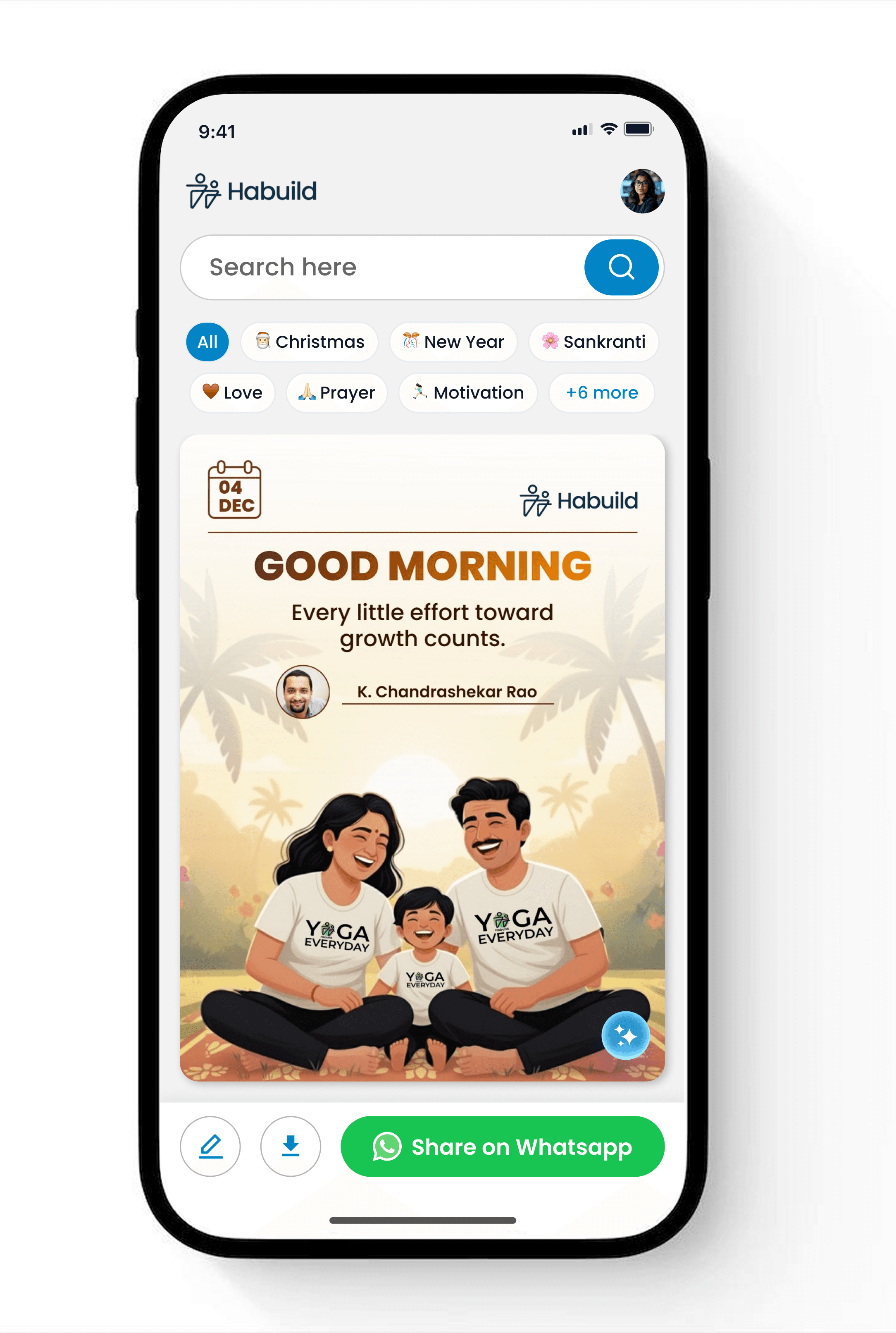
Onboarding: pick your language, upload your photo, add your name. Done. Every post on the platform then shows up personalised with your face and name on it. One tap to share on WhatsApp. We also embedded an optional Habuild join link in every share, therefore every post became a referral too. Users could remove it if they wanted. V1 went from kickoff to launch in under a month.


final version for v1 launch


Phase 2
Meet them where they already are
We added life event posters - birthdays, anniversaries etc, where users could drop in a photo of the person they were celebrating and send a personalised card.
But the bigger change was WhatsApp automation: type "good morning" in Habuild's WhatsApp channel, and you instantly get a poster back to forward. No browser, no app - just WhatsApp. Usage roughly doubled.

whatsapp autoamtion
Phase 3
Add a layer of depth
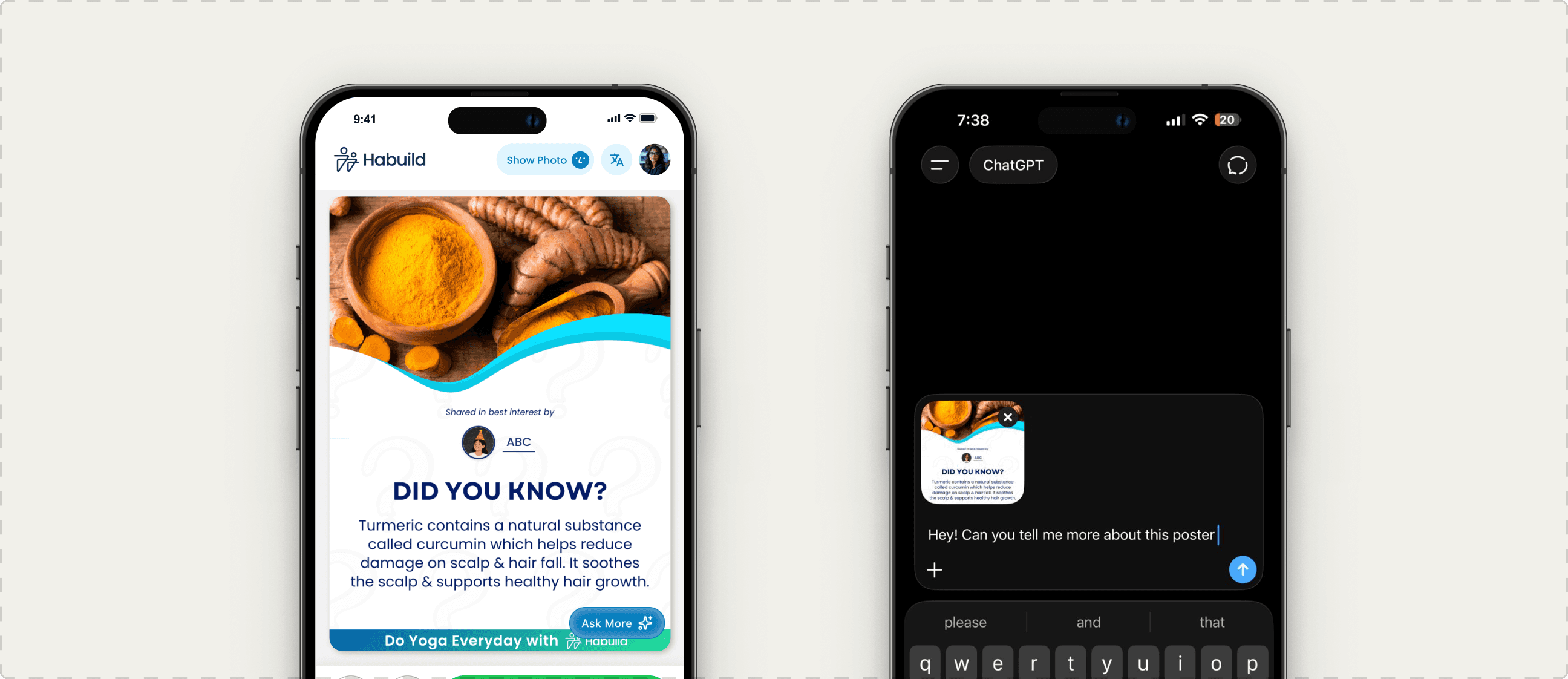
Habuild's posts are often informational. So we added an AI button on each post — tap it and it opens a ChatGPT conversation about that topic. Users can go deeper on whatever they just read. It's live across the full user base now.
The moment that humbled me
I added a simple toggle — show your photo on the post, or don't. Totally standard UI. After launch, users just didn't get it. They needed plain text that said exactly what it did, in a space that was already tight. We went through a bunch of iterations to make it fit. It was a good reminder: what feels "obvious" to me as a designer is not obvious to a 60-year-old using a web app for the first time.
version live

number of iterations

A peek behind the curtain a.k.a the admin panel
The admin panel was my territory too. It was interesting thinking from the other side, how content gets created, managed, and pushed to users. Felt like a proper full-stack designer moment.
impact
We had an amazing response and reached to 3 lakh people who signup for this, in just 5 months
3 lakh users reached
2x growth after v2
trade-offs
We kept it boring on purpose.
No rewards or gamification in v1 or v2 — we wanted to see how people naturally behaved before adding incentives. That's still in progress.
No animations, no fancy interactions. Every time I wanted to try something modern, I asked myself if my mum's friend would get it. Usually the answer was no.
reflections
Ship fast, but watch closely.
The toggle issue would've been caught earlier with real usability testing on the actual audience. I learned that for users with very different mental models, you can't assume anything, you have to test it, even when it feels unnecessary.

